Showing posts with label 1961. Show all posts

Monday, December 12, 2022

#289 Gordy Coleman - Cincinnati Reds


Gordon Calvin Coleman
Cincinnati Reds
First Base

Bats:  Left  Throws:  Right  Height:  6'3"  Weight:  215
Born:  July 5, 1934, Rockville, MD
Signed:  Signed by the Cleveland Indians as an amateur free agent before 1953 season
Major League Teams:  Cleveland Indians 1959; Cincinnati Reds 1960-1967
Died:  March 12, 1994, Cincinnati, OH (age 59)

Gordy Coleman played parts of nine seasons in the majors and was the regular first baseman for the 1961 National League pennant-winning Reds.  Coleman's best year professionally came as a member of the Mobile Bears of the Southern Association, an Indians minor league affiliate, in 1959.  After missing two full seasons due to military service, Coleman returned to baseball in 1959 and won his league's triple crown, batting .353 with 30 home runs and 110 RBIs.  He appeared in only six games for the Indians before he was dealt to the Reds with Billy Martin and Cal McLish for Johnny Temple in December 1959.  Coleman saw regular playing time with the Reds between 1961 and 1963, and his home run in Game 2 of the 1961 World Series against the Yankees helped lead to the only Reds win of the series.

He'd lose playing time to Deron Johnson (#75) and then Tony Perez (#581), last appearing in the majors in 1967.  In 773 big league games, Coleman batted .273 with 98 home runs and 387 RBIs.  Coleman was elected into the Cincinnati Reds hall of Fame in 1972, and he'd work for the team over the next several decades first in their public relations department as director of the speakers bureau, and later as a color commentary on Reds television broadcasts between 1990 and 1994.

Building the Set
December 3, 2022 from The Philly Show (Bob Lennon) - Card #596
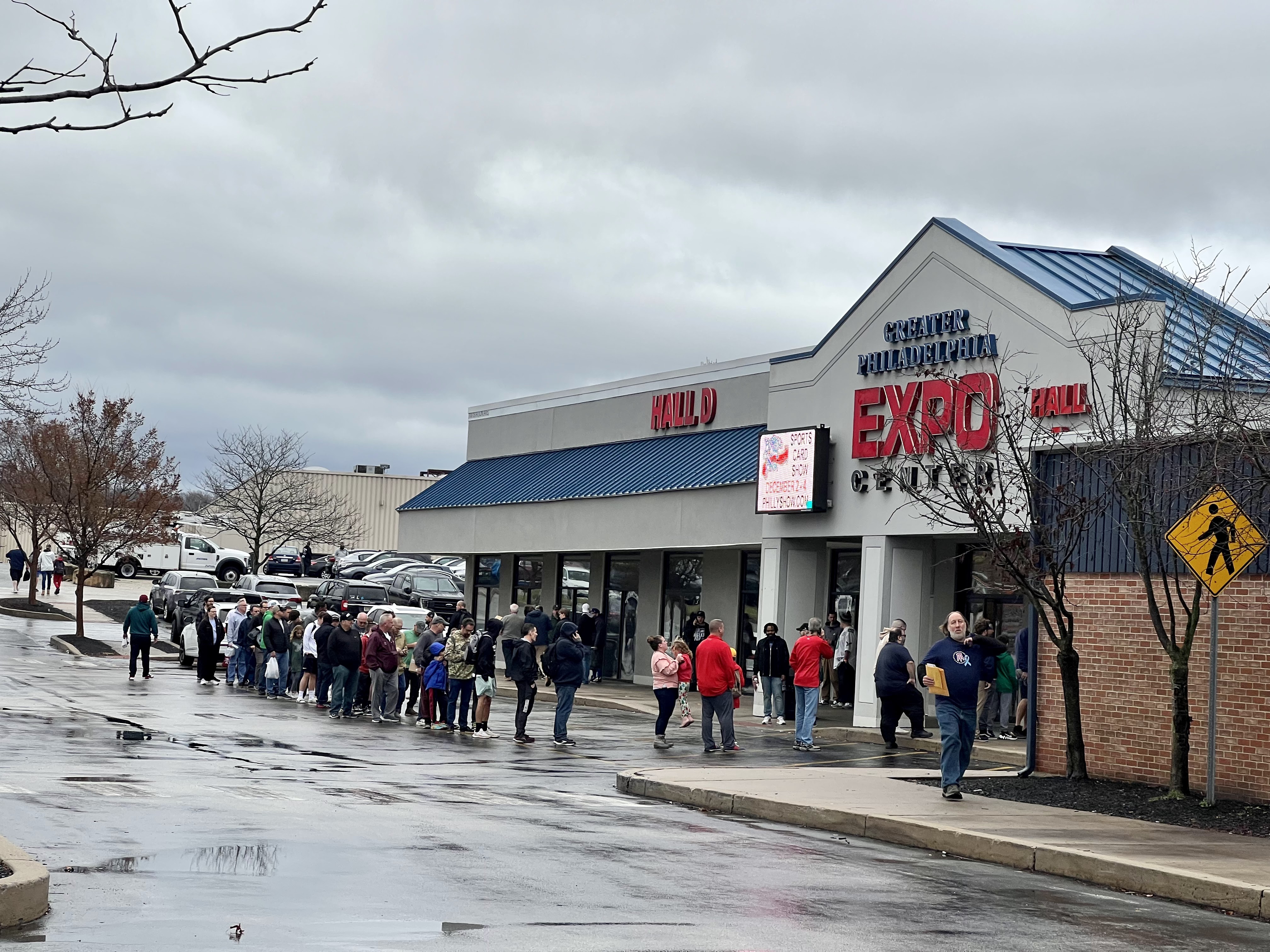
This was the second of four final cards acquired for our set at The Philly Show, the Philadelphia Sports Collectors Show, held within the Greater Philadelphia Expo Center in Oaks, Pennsylvania.  We arrived at the show in a steady rain right after doors opened at 9am, secured our autograph tickets and started walking the floor prior to the arrival of most of the crowd.  My goal for the show was simple:  Find the last four cards needed to complete our 1965 Topps set.  I wrote a full summary of the show in this post over at The Phillies Room.

The first two cards needed to complete our set took a while to find, but I eventually added the Orlando Cepeda (#360) card and this Coleman card within the first hour of walking around.  I still have no idea why the Coleman card proved to be so elusive.  I had seen the card at various shows throughout the past few years, but all copies seemed to be banged up with soft corners.  This card is the best version of the card I had come across.  Spying a great looking 1969 Topps Roberto Clemente (#160) card at the same table I found the Coleman card, I swung a deal to add that card as well.  I told the dealer the Clemente card marked our first big purchase for our new 1969 Topps set, which seemed to genuinely make his day.  Two down, two to go.

The Card / Reds Team Set
The back of the card highlights Coleman's big World Series home run.  With the Yankees holding a 1-0 advantage, Game 2 started with three scoreless innings.  Coleman connected for a two-run home run in the fourth off Ralph Terry (#406) with Frank Robinson (#120) scoring ahead of him.  The home run would become somewhat moot a half inning later when Yogi Berra (#470) hit a two-run home run of Reds' pitcher Joey Jay (#174) to tie the score.  A big hit from Johnny Edwards (#418) in the sixth gave the Reds a 3-2 lead and they'd go on to win their only game with the Yankees ultimately winning in five.

This is the last common card to be added to our set and therefore the last common card I'll post about on this blog.  One of the side effects of blogging through 598 cards is I've picked up a lot of baseball knowledge from the mid-1960s I would have otherwise never had.  Guys like Coleman need to be appreciated and remembered, and I'd be remiss if I didn't acknowledge what an unbelievably important resource the SABR website is.

1965 Season
Coleman was again the Reds' opening day first baseman, and he'd settle into a platoon with the right-handed hitting Perez.  Coleman totaled 87 starts at first base, with Perez making 66 starts.  In 108 total games, Coleman batted .302 with 14 home runs and 57 RBIs.

1960 Topps #257
1961 Topps #194
1962 Topps #508
1964 Topps #577
1967 Topps #61

Other Notable Baseball Cards

First Mainstream Card:  1960 Topps #257
Topps Flagship Set Appearances (8):  1960-1967
Most Recent Mainstream Card:  1967 Topps #61

49 - Coleman non-parallel baseball cards in the Beckett online database as of 12/4/22.

Sources:  
Baseball Reference
Beckett Database
SABR
The Trading Card Database

Monday, December 5, 2022

#360 Orlando Cepeda - San Francisco Giants


Orlando Manuel Cepeda
San Francisco Giants
First Base

Bats:  Right  Throws:  Right  Height:  6'2"  Weight:  210
Born:  September 17, 1937, Ponce, Puerto Rico
Signed:  Signed by the New York Giants as an amateur free agent before 1955 season
Major League Teams:  San Francisco Giants 1958-1966; St. Louis Cardinals 1966-1968; Atlanta Braves 1969-1972; Oakland Athletics 1972; Boston Red Sox 1973; Kansas City Royals 1974
Hall of Fame Induction:  1999

Nicknamed "Cha Cha" and "the Baby Bull," Orlando Cepeda was one of the most feared sluggers of his era, earning a spot on 11 All-Star teams and winning MVP honors in 1967.  At just 20 years old, Cepeda was the opening day first baseman in the Giants' first game in San Francisco in 1958, and his stellar season would lead to unanimous Rookie of the Year honors.  He batted .312 while leading the league with 38 doubles, finishing second on his team behind Willie Mays (#250) with 25 home runs and tying Mays for the team lead with 96 RBIs.  Cepeda would have one of his best seasons in 1961, batting .311 while leading the league with 46 home runs and 142 RBIs - both career bests.  Traded to the Cardinals in May 1966 for pitcher Ray Sadecki (#230), Cepeda proved to be a catalyst for St. Louis, leading them to a World Championship in 1967.  He was the unanimous choice for the league's MVP.

Dealt again, this time to Braves before the start of the 1969 season, Cepeda helped lead Atlanta to the first N.L. West division title.  He moved to the American League for the 1973 season, winning the first Outstanding Designated Hitter Award with the Red Sox.  He retired with 2,351 hits, a lifetime .297 batting average, 379 home runs and 1,365 RBIs.  Personal problems kept him away from the game for a bit, but he'd come back to the Giants as a scout and team ambassador in 1987.  Cepeda was inducted into the Hall of Fame in 1999 by the Veterans Committee, with the Giants retiring his #30 that same year.

Building the Set

December 3, 2022 from The Philly Show (Oldfootball.com - Mercersburg, PA) - Card #595
This was the first of four final cards acquired for our set at The Philly Show, the Philadelphia Sports Collectors Show, held within the Greater Philadelphia Expo Center in Oaks, Pennsylvania.  We arrived at the show in a steady rain right after doors opened at 9am, secured our autograph tickets and started walking the floor prior to the arrival of most of the crowd.  My goal for the show was simple:  Find the last four cards needed to complete our 1965 Topps set.  I wrote a full summary of the show in this post over at The Phillies Room.

The first two cards needed to complete our set took a while to find, but I eventually added this Cepeda card and the Gordy Coleman (#289) card within the first hour of walking around.  Cepeda was found in box of commons and semi-stars at the table hosted by A.J. Firestone of oldfootball.com, from Mercersburg.  I didn't balk at the $12 price tag, gladly paying the price and getting the Cepeda back from the dealer in a sandwich bag.  One down, three to go.

The Card / Giants Team Set
Cepeda first appeared in the set on the Home Run Leaders card (#4) with teammates Mays and Jim Ray Hart (#395).  The back of the card highlights his Rookie of the Year win in 1958, even though the cartoon shows him receiving an MVP award.  His average of .304 was indeed tops on the Giants in 1964, with Mays behind him at .296.  Mays was second in doubles as well with 21 to Cepeda's 27.  The card is reprinted, albeit in a stylized painted format, in the 2001 Topps Gallery Heritage insert set.

1965 Season
Chronic knee problems plagued Cepeda throughout his career, and in 1965 he was limited to just 33 games throughout the season.  He appeared in seven games through early May, mainly as a pinch-hitter, before landing on the disabled list.  Returning in mid-August, Cepeda was again used almost exclusively as a pinch-hitter, making five starts all season.  He batted .176 with a home run and five RBIs in the worst season of his big league career.  Cepeda had offseason knee surgery, making a successful comeback in 1966.

1958 Topps #343
1961 Topps #435
1964 Topps #390
1967 Topps #20
1974 Topps #83

Other Notable Baseball Cards

First Mainstream Card:  1958 Topps #343
Topps Flagship Set Appearances (18):  1958-1975
Most Recent Mainstream Card:  2022 Topps Heritage Real One Autographs #ROA-OC

1,075 - Cepeda non-parallel baseball cards in the Beckett online database as of 12/3/22.

Sources:  
Baseball Reference
Beckett Database
National Baseball Hall of Fame
SABR
The Trading Card Database

Monday, October 24, 2022

#380 Rocky Colavito - Cleveland Indians


Rocco Domenico Colavito
Cleveland Indians
Outfield

Bats:  Right  Throws:  Right  Height:  6'3"  Weight:  190
Born:  August 10, 1933, New York, NY
Signed:  Signed by the Cleveland Indians as an amateur free agent before 1951 season
Major League Teams:  Cleveland Indians 1955-1959; Detroit Tigers 1960-1963; Kansas City Athletics 1964; Cleveland Indians 1965-1967; Chicago White Sox 1967; Los Angeles Dodgers 1968; New York Yankees 1968

One of the most prolific power hitters of the late 1950s and early 1960s, slugger Rocky Colavito played for 14 seasons in the majors, accumulating 374 career home runs.  He made his debut with the Indians late in the 1955 season, and was the runner-up for Rookie of the Year in 1956, his first of 11 straight seasons with at least 20 home runs.  Colavito led the league with a .620 slugging percentage in 1958 and drove in 113 runs, the first year out of six total in which he'd eclipse the century mark for RBIs.  In 1959, he was named to the first of nine All-Star teams and led the league with 42 home runs.  On June 10, 1959, Colavito connected for four consecutive home runs against the Orioles, joining Lou Gehrig as the second player in American League history with four home runs in a game.

1964 Topps Giants #9
Surprisingly dealt to the Tigers right before the start of the 1960 season for batting champion Harvey Kuenn (#103), the fan favorite left Cleveland and continued his impressive slugging in Detroit.  With the Tigers in 1961, he hit .290 with career highs in both home runs (45) and RBIs (140).  He'd return to Cleveland for the 1965 season in an eight-player, three-team trade, leading the league in RBIs with 108.  Always an above-average defender, in 1965 he would become the first American League outfielder to play a complete season with a perfect 1.000 fielding percentage.  Colavito spent the final two years of his playing career as a bench player and pinch-hitter for the Indians, White Sox, Dodgers and Yankees.  He tallied 1,730 hits while batting .266 and driving in 1,159.  He'd later coach for the Indians (1973, 1976-1978) and Royals (1982-1983) and was one of four ejected during the 1983 pine tar game between the Royals and Yankees.  Joining Colavito with ejections in that game were George Brett, Royals' manager Dick Howser (#92) and Yankees' pitcher Gaylord Perry (#193).

Building the Set
May 3, 2022 from Wenonah, NJ (Gar Miller Cards) - Card #589
Growing up in South Jersey, I'd look forward to the Ocean City Baseball Card show every summer, saving my precious birthday or gas mowing money so that I could spend it all during one glorious afternoon inside the Ocean City Music Pier among dozens of tables of vintage baseball cards.  When my wife Jenna texted me that there was a baseball card show coming up in Ocean City on April 30th, I admittedly got giddy.  We needed 11 cards to complete our 1965 Topps set, I had plans to begin collecting a 1969 Topps set, and I figured I'd add a Diamond Stars card or two to that growing set.  We loaded the family in the car, trekked down to Ocean City, and I stepped inside the Music Pier for the first time in over 20 years.

The memories came flooding back, but none of the former baseball card dealers from my youth did.  There were maybe 15 tables scattered on the lower portion of the Music Pier floor and I immediately scanned mostly shiny slabbed cards, bobble heads, signed jerseys, and nary a vintage baseball card in sight.  It was a little depressing.  Determined to come away with something, anything for my collection, I scoured a "3 for $20" box and came away with a few cards for Doug's collection, namely Alec Bohm relic cards, and six cards from sets I'm not even collecting yet.

All of this is meant as a prelude to how this Colavito card ended up in my collection.  My budgeted show money burning a hole in my pocket, I navigated over to Gar Miller Cards' online store when we got home and held my own virtual baseball card show.  I added four cards to our Diamond Cards set, crossed off three more cards for our 1965 Topps set and threw in a few cool cards to add to the 1969 Topps pile I've started.

The Card / Indians Team Set
Topps blacked out the Athletics' logo on Colavito's hat, recycling a photo first used for the 1964 Topps Giants set.  The back of the card highlights his four home runs in a game performance from 1959, as well as his re-acquisition by the Indians.

I've now written about the massive eight-player trade that brought Colavito back to Cleveland for the 1965 season in eight posts, and I wanted to show all the players together in one mini gallery below.  As the set progressed into the third series, Topps started updating the players' team designations, beginning with the Tommy John (#208) card.

#17 - Indians to White Sox
#166 - Indians to White Sox
#208 - Indians to White Sox
#578 - White Sox to Indians
#89 - White Sox to Athletics
#376 - White Sox to Athletics
#58 - White Sox to Athletics
#380 - Athletics to Indians

1965 Season
Playing again for the Indians for the first time since 1959, Colavito started all 162 of the team's games in right field.  He batted .287 with 26 home runs and a team-leading 108 RBIs, as the Indians finished in fifth place.  He led the league in RBIs and walks (93), and was the starting right fielder for the American League All-Stars.  On September 6th, Colavito collected his 1,000th career RBI in the second game of a double header against the Senators.

1957 Topps #212
1959 Topps #420
1961 Topps #330
1966 Topps #150
1968 Topps #99

Other Notable Baseball Cards

First Mainstream Card:  1957 Topps #212
Topps Flagship Set Appearances (13):  1957-1968, 1973
Most Recent Mainstream Card:  2014 Panini Golden Age #81

243 - Colavito non-parallel baseball cards in the Beckett online database as of 10/18/22.

Sources:  
Baseball Reference
Beckett Database
SABR
The Trading Card Database

Thursday, October 20, 2022

#470 Yogi Berra - New York Mets


Lawrence Peter Berra
New York Mets
Catcher-Coach

Bats:  Left  Throws:  Right  Height:  5'7"  Weight:  185
Born:  May 12, 1925, St. Louis, MO
Signed:  Signed by the New York Yankees as an amateur free agent before 1943 season
Major League Teams:  New York Yankees 1946-1963, New York Mets 1965
As a Manager:  New York Yankees 1964; New York Mets 1972-1975; New York Yankees 1984-1985
Hall of Fame Induction:  1972
Died:  September 22, 2015, West Caldwell, NJ (age 90)

1982 Donruss #387
One of the best, if not the best, catchers of his era, Yogi Berra was an All-Star every year between 1948 and 1962, won MVP honors in 1951, 1954 and 1955, and was a key component in bringing 10 World Championship titles to the Yankees.  Berra is one of the most recognizable and beloved baseball figures in history.

Signed by the Yankees in 1943, Berra didn't make his debut until 1946 as he was serving in the Navy during World War II.  He earned a Purple Heart taking part in the Normandy landings.  At the end of the war, Berra quickly established himself as one of the best power hitters and defensive catchers in the majors.  Over 19 seasons, he hit .285 with 2,150 hits, 358 home runs and 1,430 RBIs.  Upon his retirement, he held the records for most plate appearances (8,359), hits, home runs, runs (1,175) and RBIs among all catchers.

Following his playing days, Berra didn't stray far from baseball, keeping busy with both the Yankees and the Mets.  He briefly managed the Yankees in 1964 before moving to the Mets as a coach between 1965 and 1971, and then as manager between 1972 and 1975.  He returned to the Yankees as a coach between 1976 and 1983, and again as manager in 1984 and 1985.  His final coaching job came with the Astros between 1986 and 1989.  The Yankees retired Berra's #8 in 1972, the same year he was inducted into the Hall of Fame.  Berra and Johnny Bench were named as catchers on MLB's All-Century team in 1999.

The Donruss card above is the first card of Berra's I ever owned, and I remember thinking to myself when I pulled it from a pack back then, "Is this a real person?"

Some text for this post originally appeared on  my 1956 Topps blog.

Building the Set
April 25, 2022 from Los Angeles, CA - Card #587
Nearly two months passed between us adding 102 cards at the March Philly Show, and the next card added to the set, this iconic Berra card.  I placed opening bids on several Greg Morris Cards auctions on eBay at some point in mid-April and walked away.  Greg Morris Cards seemingly has a set break every other week, and the prices on some of the auctions often get out of control in my opinion.  But as I often do, I probably bid on 10 or 15 cards at the auctions' outset and then walked away until the auctions concluded.  This Berra was the only one of the cards I bid on that made it through to me at what I thought was a relatively low bid.  Once the card arrived in late April, we were down to needing just 11 more cards for the set.

In April 2022 we were attending our first Phillies games of the season.  Doug was busy with high school baseball and Ben had started to run track for his middle school.  Ben celebrated his 12th birthday, complete with a new ping pong table.  There was quite a lot going on, but I was thankful for all of it.

April 11, 2022 - Doug at the plate
April 8, 2022 - Home Opener
April 21, 2022 - Ben on the track

The Card / Mets Team Set
This is such a strange card when you fully consider the circumstances during which it was issued.  It's also the third and final player-coach card in the set, joining Warren Spahn (#205) and Nellie Fox (#485).  Berra had managed the Yankees in 1964 to the World Series, and he was dismissed following the team's loss to the Cardinals in seven games.  The Mets signed him as a player-coach on April 27, 1965, meaning Topps had to rush to get this card into packs within the set's sixth series.  Berra is clearly in Yankee pinstripes here, and the back of the card shows his full career statistics while with the Bronx Bombers.  There's a final line included for 1964, telling collectors he had been the "N.Y. Mgr." and therefore "DID NOT PLAY."  This was Berra's last appearance in a Topps flagship set until he appeared on a card in the 1973 Topps set as the Mets' manager.

1965 Season
Berra made four cameo appearances with the Mets as a player, pinch-hitting twice and catching two full and final games on May 4th against the Phillies and May 9th against the Braves.  He caught Al Jackson's (#381) complete game victory in the start against the Phillies, going 2 for 3 at the plate.  Berra was again behind the plate for Jackson's start on May 9th, but the pitcher didn't escape the third inning, allowing five runs on nine hits.  Tom Parsons (#308) was the last pitcher to throw to Berra in the ninth inning of the 8-2 loss.  He batted .222 (2 for 9) in his brief return as a player before settling in to a full time coach's job.

1948 Bowman #6
1952 Topps #191
1961 Topps #425
1974 Topps #179
1987 Topps #531

Other Notable Baseball Cards
First Mainstream Card:  1948 Bowman #6
Topps Flagship Set Appearances (21):  1951-1965, 1973-1975, 1984-1985, 1987
Most Recent Mainstream Card:  2022 Topps Now #746

2,212 - Berra non-parallel baseball cards in the Beckett online database as of 10/10/22.

Sources:  
1956 Topps Blog

Monday, October 10, 2022

#444 Bob Hendley - San Francisco Giants


Charles Robert Hendley
San Francisco Giants
Pitcher

Bats:  Right  Throws:  Left  Height:  6'2"  Weight:  190
Born:  April 30, 1939, Macon, GA
Signed:  Signed by the Milwaukee Braves as an amateur free agent, August 17, 1957
Major League Teams:  Milwaukee Braves 1961-1963; San Francisco Giants 1964-1965; Chicago Cubs 1965-1967; New York Mets 1967

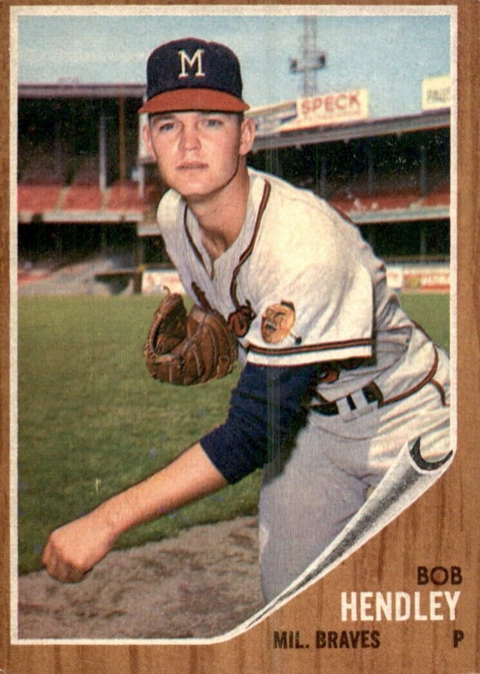
A lefty swingman throughout his seven years in the majors, Bob Hendley earned a lifetime record of 48-52 with a 3.97 ERA, 25 complete games and 522 strikeouts.  His seasons were often abbreviated due to consistent and lingering elbow problems.  Hendley was an 11-game winner with the Braves in 1962, pitching in a career-high 200 innings.  Dealt to the Giants before the 1964 season, he'd win 10 games in San Francisco and strike out at least 100 batters for the third season in a row.  Hendley would spend parts of three seasons with the Cubs, mostly as a reliever, and a half season with the Mets in 1967.  He'd pitch two full seasons in the Mets' minor league system in 1968 and 1969, leaving the game following the 1969 season.  (He received a Mets card in the 1969 Topps set, but had last pitched for the club in September 1967.)

Following his playing days, Hendley was a long-time youth baseball pitching coach, working with various schools in his home state of Georgia.  In 2015, he was inducted into the Georgia Sports Hall of Fame.


Building the Set

March 6, 2022 from The Philly Show (Sports Cards Plus - Cooper City, FL) - Card #579
This is the 95th of 102 cards acquired for our set from the Baseball Card Sports Memorabilia Show, affectionately known as The Philly Show, held in the basement of the Valley Forge Casino Resort in King of Prussia in early March.  We went nuts and left the show needing only 12 more cards to complete our 1965 Topps set, and I wrote about the show in detail over at The Phillies Room.  After our 51 card haul from Uncle Dick's, and with more card spending budget still in place, I set out to find another dealer with a binder of 1965 Topps cards with reasonable prices.  I had purchased cards from Sports Cards Plus before, finding the last few cards needed for our 1971 Topps set from this dealer back in December 2019.

Settling in, we found 37 cards needed for our set with an average price per card working out to around $6.  The lot, including this Hendley card, consisted mostly of semi-stars and team cards.  After paying for this mini haul, we were officially 13 cards away from a complete set, with one more purchase coming to end the day.

The Card / Giants Team Set
Hendley would have already been with the Cubs (see below) by the time this card started appearing in packs.  The back of the card celebrates his 1959 success with the Austin Senators in the Texas League when he had a league-leading 2.95 ERA.

1965 Season
Hendley began the season with the Giants, and was traded to the Cubs on May 29th with Ed Bailey (#559) and Harvey Kuenn (#103) for Dick Bertell (#27) and Len Gabrielson (#14).  With the Cubs, Hendley took part in two memorable pitching duels with the Dodgers' Sandy Koufax (#300).  On September 9th, Hendley and Koufax were both pitching no-hitters when Lou Johnson blooped a double over the head of first baseman Ernie Banks (#510) in the bottom of the seventh.  Koufax would go on to pitch a perfect game, with Hendley the losing pitcher despite allowing one hit and no earned runs.  The two pitchers would meet again on September 14th at Wrigley Field, with Hendley besting Koufax this time as the Cubs won, 2-1.

In total for the season with the Giants and Cubs, Hendley was 4-4 in 26 games with a 5.96 ERA in 77 innings pitched.  He also made seven starts for the Salt Lake City Bees, then the Cubs' top farm team, going 3-4 with a 2.94 ERA.

1961 Topps #372
1962 Topps #361
1966 Topps #82
1967 Topps #256
1969 Topps #144

Other Notable Baseball Cards

First Mainstream Card:  1961 Topps #372
Topps Flagship Set Appearances (9):  1961-1969
Most Recent Mainstream Card:  1969 Topps #144

26 - Hendley non-parallel baseball cards in the Beckett online database as of 10/2/22.

Sources:  
Baseball Reference
Beckett Database
SABR
The Trading Card Database