Showing posts with label 1960. Show all posts

Monday, December 12, 2022

#289 Gordy Coleman - Cincinnati Reds


Gordon Calvin Coleman
Cincinnati Reds
First Base

Bats:  Left  Throws:  Right  Height:  6'3"  Weight:  215
Born:  July 5, 1934, Rockville, MD
Signed:  Signed by the Cleveland Indians as an amateur free agent before 1953 season
Major League Teams:  Cleveland Indians 1959; Cincinnati Reds 1960-1967
Died:  March 12, 1994, Cincinnati, OH (age 59)

Gordy Coleman played parts of nine seasons in the majors and was the regular first baseman for the 1961 National League pennant-winning Reds.  Coleman's best year professionally came as a member of the Mobile Bears of the Southern Association, an Indians minor league affiliate, in 1959.  After missing two full seasons due to military service, Coleman returned to baseball in 1959 and won his league's triple crown, batting .353 with 30 home runs and 110 RBIs.  He appeared in only six games for the Indians before he was dealt to the Reds with Billy Martin and Cal McLish for Johnny Temple in December 1959.  Coleman saw regular playing time with the Reds between 1961 and 1963, and his home run in Game 2 of the 1961 World Series against the Yankees helped lead to the only Reds win of the series.

He'd lose playing time to Deron Johnson (#75) and then Tony Perez (#581), last appearing in the majors in 1967.  In 773 big league games, Coleman batted .273 with 98 home runs and 387 RBIs.  Coleman was elected into the Cincinnati Reds hall of Fame in 1972, and he'd work for the team over the next several decades first in their public relations department as director of the speakers bureau, and later as a color commentary on Reds television broadcasts between 1990 and 1994.

Building the Set
December 3, 2022 from The Philly Show (Bob Lennon) - Card #596
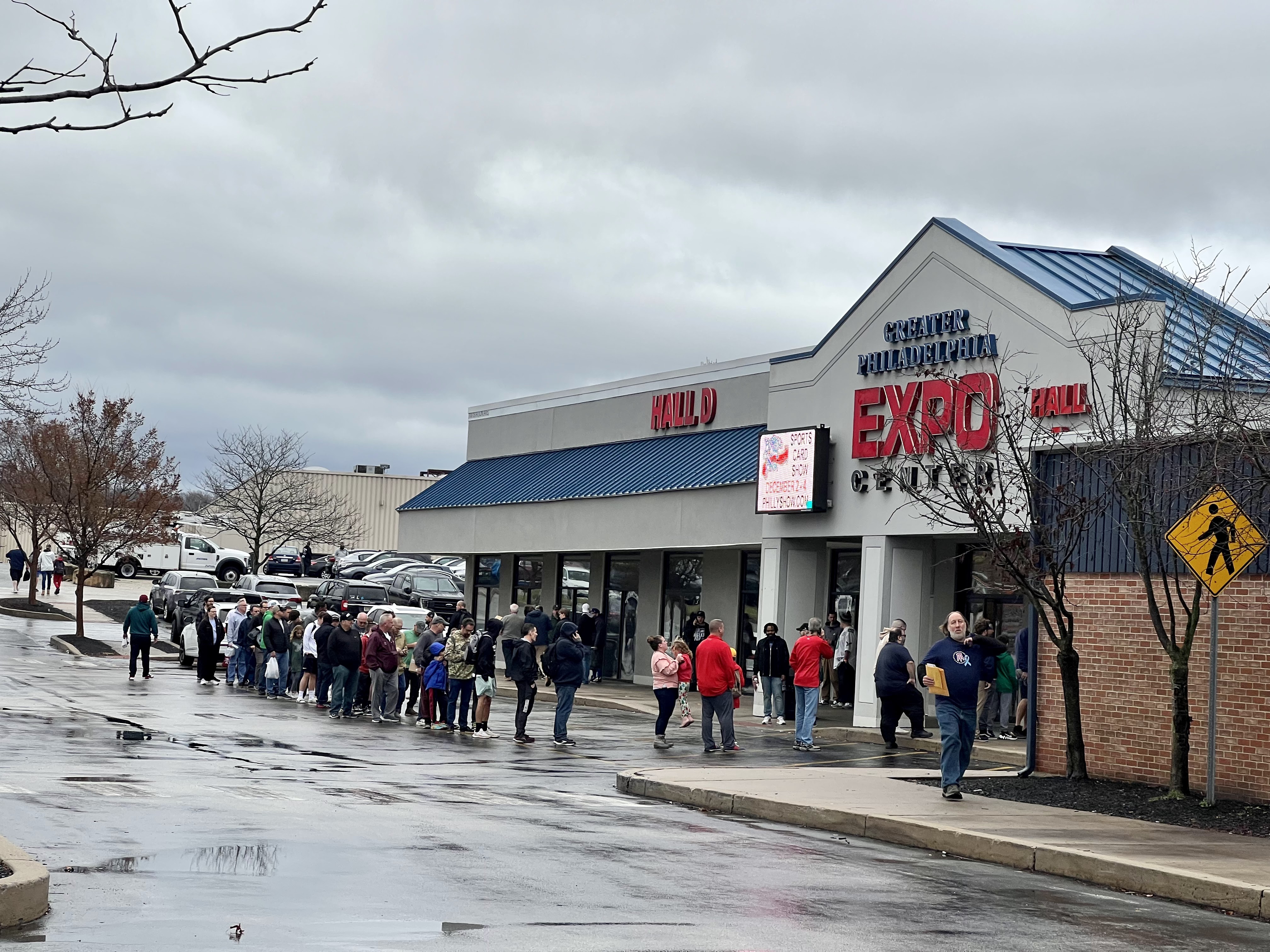
This was the second of four final cards acquired for our set at The Philly Show, the Philadelphia Sports Collectors Show, held within the Greater Philadelphia Expo Center in Oaks, Pennsylvania.  We arrived at the show in a steady rain right after doors opened at 9am, secured our autograph tickets and started walking the floor prior to the arrival of most of the crowd.  My goal for the show was simple:  Find the last four cards needed to complete our 1965 Topps set.  I wrote a full summary of the show in this post over at The Phillies Room.

The first two cards needed to complete our set took a while to find, but I eventually added the Orlando Cepeda (#360) card and this Coleman card within the first hour of walking around.  I still have no idea why the Coleman card proved to be so elusive.  I had seen the card at various shows throughout the past few years, but all copies seemed to be banged up with soft corners.  This card is the best version of the card I had come across.  Spying a great looking 1969 Topps Roberto Clemente (#160) card at the same table I found the Coleman card, I swung a deal to add that card as well.  I told the dealer the Clemente card marked our first big purchase for our new 1969 Topps set, which seemed to genuinely make his day.  Two down, two to go.

The Card / Reds Team Set
The back of the card highlights Coleman's big World Series home run.  With the Yankees holding a 1-0 advantage, Game 2 started with three scoreless innings.  Coleman connected for a two-run home run in the fourth off Ralph Terry (#406) with Frank Robinson (#120) scoring ahead of him.  The home run would become somewhat moot a half inning later when Yogi Berra (#470) hit a two-run home run of Reds' pitcher Joey Jay (#174) to tie the score.  A big hit from Johnny Edwards (#418) in the sixth gave the Reds a 3-2 lead and they'd go on to win their only game with the Yankees ultimately winning in five.

This is the last common card to be added to our set and therefore the last common card I'll post about on this blog.  One of the side effects of blogging through 598 cards is I've picked up a lot of baseball knowledge from the mid-1960s I would have otherwise never had.  Guys like Coleman need to be appreciated and remembered, and I'd be remiss if I didn't acknowledge what an unbelievably important resource the SABR website is.

1965 Season
Coleman was again the Reds' opening day first baseman, and he'd settle into a platoon with the right-handed hitting Perez.  Coleman totaled 87 starts at first base, with Perez making 66 starts.  In 108 total games, Coleman batted .302 with 14 home runs and 57 RBIs.

1960 Topps #257
1961 Topps #194
1962 Topps #508
1964 Topps #577
1967 Topps #61

Other Notable Baseball Cards

First Mainstream Card:  1960 Topps #257
Topps Flagship Set Appearances (8):  1960-1967
Most Recent Mainstream Card:  1967 Topps #61

49 - Coleman non-parallel baseball cards in the Beckett online database as of 12/4/22.

Sources:  
Baseball Reference
Beckett Database
SABR
The Trading Card Database

Monday, November 21, 2022

#385 Carl Yastrzemski - Boston Red Sox


Carl Michael Yastrzemski
Boston Red Sox
Outfield

Bats:  Left  Throws:  Right  Height:  5'11"  Weight:  175
Born:  August 22, 1939, Southampton, NY
Signed:  Signed by the Boston Red Sox as an amateur free agent, November 29, 1958
Major League Teams:  Boston Red Sox 1961-1983
Hall of Fame Induction:  1989

For over two decades, Carl Yastrzemski was a mainstay at Fenway Park, as the team's regular left fielder, then first baseman and finally designated hitter.  One of the all-time Red Sox fan favorites, Yastrzemski made his first of 18 All-Star teams in 1963, while also being awarded his first of seven Gold Gloves.  That was also the season he won his first of three batting titles with a .321 average.  He'd produce consistently stellar seasons throughout the 1960s, culminating with his triple crown win in 1967 (.326 average, 44 home runs, 121 RBIs) en route to the league MVP award and an American League pennant for his Impossible Dream Red Sox.  Yastrzemski continued his superstar output throughout the 1970s, again helping to lead the Red Sox to the World Series in 1975.  On September 12, 1979, he became the first American League player with 3,000 career hits and 400 home runs.

He retired at the end of the 1983 season having appeared in 3,308 games, 2nd on the all-time list behind Pete Rose (#207).  His career at-bats (11,988), hits (3,419), doubles (646) and walks (1,845) are all currently in the top ten all-time.  Yastrzemski tallied 452 home runs and 1,844 RBIs, and along with Ted Williams, the player he replaced, is at the top of just about every offensive category on the Red Sox all-time lists.  His #8 was retired by the Red Sox in 1989, the same year he was inducted into the Hall of Fame on his first ballot.

Building the Set
September 15, 2022 from San Diego, CA (Kit Young Cards) - Card #593
This card was part of a larger stress-induced purchase from Kit Young Cards in mid-September.  The stress was all work related, and while some people choose to relieve stress through less productive means, I opted to purchase several vintage baseball cards.  The centerpiece of the haul was this Yaz card, which dropped the number of cards needed for our complete set down to five.  Joining Yaz were Diamond Stars cards of Joe Stripp and Lloyd Waner, along with a League Leaders card from the 1969 Topps set, which will be my focus after the last five cards needed from 1965 are tracked down.  

September 2022 was a blur.  I travelled for work the better part of two weeks, school started, the boys' fall sports schedules (cross country and baseball) were non-stop and there was little to no time to rest or to enjoy baseball card purchases.  Taking a mental health day in early October, I was happy to have the time to catch my breath and truly appreciate the new baseball cards that helped get me through that month.

The Card / Red Sox Team Set
I feel this is an iconic baseball card, and I love it's now in our collection.  Topps reprinted this card for its 2010 Topps Cards Your Mom Threw Out insert set.  Yastrzemski's name appears in white text on the front of the card, while every other Red Sox card in the set uses yellow for the player's name.  The back of the card mentions his two batting titles to date, in 1959 in the Carolina League and in 1963.  Yastrzemski's fielding skills often get overlooked, and he led all outfielders in assists in seven different seasons between 1962 and 1977.

1965 Season
The Red Sox would lose 100 games, but the all-star play of Yastrzemski gave fans reasons to hope.  In 133 games, Yastrzemski batted .312 with 20 home runs and 72 RBIs as the club's regular left fielder for the fifth straight season.  He hit for the cycle on May 14th, adding an extra home run for bonus points.  On September 25th, the Red Sox faced off against the Athletics and their starting pitcher, 58-year-old Satchel Paige.  Paige pitched three innings with Yastrzemski collecting the only hit, a double, against him.

1960 Topps #148
1963 Topps #115
1967 Topps #355
1975 Topps #280
1983 Topps #550

Other Notable Baseball Cards

First Mainstream Card:  1960 Topps #148
Topps Flagship Set Appearances (25):  1960-1984
Most Recent Mainstream Card:  2022 Topps Pristine #149

2,870 - Yastrzemski non-parallel baseball cards in the Beckett online database as of 11/12/22.

Sources:  
Baseball Reference
Beckett Database
National Baseball Hall of Fame
SABR
The Trading Card Database

Saturday, October 22, 2022

#372 Clay Dalrymple - Philadelphia Phillies


Clayton Errol Dalrymple
Philadelphia Phillies
Catcher

Bats:  Left  Throws:  Right  Height:  6'0"  Weight:  195
Born:  December 3, 1936, Chico, CA
Acquired:  Obtained by the Milwaukee Braves from the Sacramento Solons (PCL) as part of a minor league working agreement
Major League Teams:  Philadelphia Phillies 1960-1968; Baltimore Orioles 1969-1971

Clay Dalrymple was the regular catcher for the Phillies throughout much of the 1960s, earning the job due to his handling of the pitching staff and his above average defensive skills.  Dalrymple led all catchers in assists and runners caught stealing in three different seasons (1961, 1963 and 1965).  He peaked offensively with the Phillies in 1962, hitting career highs with a .276 average, 11 home runs and 54 RBIs.  Dalrymple led the league with eight sacrifice flies in 1964, and had a front row seat for the team's collapse in September.  He was behind the plate on September 21, 1964 when Chico Ruiz (#554) stole home to give the Reds a 1-0 victory and begin the Phillies' 10-game losing streak.

Dalrymple saw his playing time decrease during his last few years with the Phillies, sharing catching duties with Pat Corrales (#107), Bob Uecker (#519), Gene Oliver (#106) and finally Mike Ryan (#573).  A target of the Phillies' fans ire, Dalrymple requested a trade and was accommodated when the team sent him to the Orioles before the 1969 season.  Having come so close to the postseason in 1964, Dalrymple finally saw October action when the Orioles won the A.L. East pennant in 1969.  He was 2 for 2 with a pair of pinch-hit singles in the Series as the Orioles fell to the Mets in five games.  A broken ankle hobbled Dalrymple his final two years in the majors, and he retired following the 1971 season.

April 30, 2022 - Inside a mostly empty Music Pier
In 1,079 career games, Dalrymple batted .233 with 710 hits, 55 home runs and 327 RBIs.  For his career, Dalrymple ranks in the top 100 (98th) for double plays turned by a catcher with 79, and his 48.8% caught stealing percentage is currently 30th all-time.  

Building the Set
May 3, 2022 from Wenonah, NJ (Gar Miller Cards) - Card #588
Growing up in South Jersey, I'd look forward to the Ocean City Baseball Card show every summer, saving my precious birthday or gas mowing money so that I could spend it all during one glorious afternoon inside the Ocean City Music Pier among dozens of tables of vintage baseball cards.  When my wife Jenna texted me that there was a baseball card show coming up in Ocean City on April 30th, I admittedly got giddy.  We needed 11 cards to complete our 1965 Topps set, I had plans to begin collecting a 1969 Topps set, and I figured I'd add a Diamond Stars card or two to that growing set.  We loaded the family in the car, trekked down to Ocean City, and I stepped inside the Music Pier for the first time in over 20 years.

The memories came flooding back, but none of the former baseball card dealers from my youth did.  There were maybe 15 tables scattered on the lower portion of the Music Pier floor and I immediately scanned mostly shiny slabbed cards, bobble heads, signed jerseys, and nary a vintage baseball card in sight.  It was a little depressing.  Determined to come away with something, anything for my collection, I scoured a "3 for $20" box and came away with a few cards for Doug's collection, namely Alec Bohm relic cards, and six cards from sets I'm not even collecting yet.

All of this is meant as a prelude to how this Dalrymple card ended up in my collection.  My budgeted show money burning a hole in my pocket, I navigated over to Gar Miller Cards' online store when we got home and held my own virtual baseball card show.  I added four cards to our Diamond Cards set, crossed off three more cards for our 1965 Topps set and threw in a few cool cards to add to the 1969 Topps pile I've started.

The Card / Phillies Team Set
With many of Dalrymple's baseball cards, including this one, there's no mistaking the player featured is a catcher.  The back of the card mentions his boxing prowess, and Dalrymple was 11-1 at Chico State, becoming heavyweight champion of the Far Western Conference.  This card completes our Phillies team set, marking it the second time I've put together a complete Phillies team set of 30 cards, with the first instance in my 1960s Phillies baseball card binder.

1965 Season
Dalrymple was back as the Phillies' regular catcher in 1965 following the September 1964 collapse.  He made 85 starts behind the plate, sharing playing time with Corrales and Gus Triandos (#248).  In 103 games overall, he batted .213 with just 14 extra base hits, including four home runs.

Phillies Career
Dalrymple played in the Braves' organization for the 1959 season, and was left unprotected in that offseason's rule 5 draft.  Selected by the Phillies in the draft on November 30, 1959, Dalrymple began the 1960 season as back-up to regular catcher Jimmie Coker (#192).  He'd take over the position full-time in 1961, making the first of five opening day starts behind the plate, with his streak broken in 1966 by Uecker.  As mentioned above, he assumed a part-time role with the club beginning in 1966, and was dealt to the Orioles on January 20, 1969 for outfielder Ron Stone.  In 1,006 games with the Phillies over nine seasons, Dalrymple batted .234, collecting 674 hits.

1960 Topps #523
1962 Topps #434
1964 Topps #191
1968 Topps #567
1971 Topps #617

Other Notable Baseball Cards

First Mainstream Card:  1960 Leaf #143
Topps Flagship Set Appearances (12):  1960-1971
Most Recent Mainstream Card:  2020 Topps Heritage Real One Autographs #ROA-CD

71 - Dalrymple non-parallel baseball cards in the Beckett online database as of 10/18/22.

Sources:  
Baseball Reference
Beckett Database
The Phillies Room
SABR
The Trading Card Database

Monday, October 3, 2022

#426 Milwaukee Braves Team Card


Beginning in 1956 and going all the way through to 1981, with a one year absence in 1969, Topps included team cards in its flagship sets.

Building the Set
March 6, 2022 from The Philly Show (Sports Cards Plus - Cooper City, FL) - Card #574
This is the 90th of 102 cards acquired for our set from the Baseball Card Sports Memorabilia Show, affectionately known as The Philly Show, held in the basement of the Valley Forge Casino Resort in King of Prussia in early March.  We went nuts and left the show needing only 12 more cards to complete our 1965 Topps set, and I wrote about the show in detail over at The Phillies Room.  After our 51 card haul from Uncle Dick's, and with more card spending budget still in place, I set out to find another dealer with a binder of 1965 Topps cards with reasonable prices.  I had purchased cards from Sports Cards Plus before, finding the last few cards needed for our 1971 Topps set from this dealer back in December 2019.

Settling in, we found 37 cards needed for our set with an average price per card working out to around $6.  The lot, including this Braves team card, consisted mostly of semi-stars and team cards.  After paying for this mini haul, we were officially 13 cards away from a complete set, with one more purchase coming to end the day.


The Card / Braves Team Set
There's a few fairly odd things about this team card.  First, Topps decided to go with a black border for the card, despite all Braves cards in the set having a green border.  Second, the photo used by Topps would have been six years old at the time this card was coming out, and it would mark the sixth time the photo was used on a Braves team card.  That's pretty bad, and I can imagine how annoyed I would have been as a young Braves fan in 1965 finding that Topps had once again recycled an old team photo.  With the team moving to Atlanta in 1966, Topps finally used an updated photo in its 1966 Topps set.

This is the last Braves card needed to complete our Braves team set, and we're down to needing just two more team cards in the set, for the Indians and the Yankees.

1960 Topps #381
1961 Topps #463
1963 Topps #503
1966 Topps #326

1965 Season
This was to be the 13th and final season of the Braves playing in Milwaukee, as they'd relocate to Atlanta Stadium in Georgia for the 1966 season.  Manager Bobby Bragan (#346) guided the club to an 86-76 record as they finished in fifth place, 11 games behind the Dodgers.  Right fielder Henry Aaron (#170) continued to star for the team, batting .318 with 32 home runs and 89 RBIs, along with a league leading 40 doubles.  Third baseman Eddie Matthews (#500) led the team with 95 RBIs.  Six Braves players hit at least 20 home runs, led by Matthews, then Aaron and followed by Mack Jones (#241), Joe Torre (#200), Felipe Alou (#383) and Gene Oliver (#106).  Aaron and Torre both started for the National League in the All-Star Game.

Tony Cloninger (#520) was the staff ace, going 24-11 with a 3.29 ERA and 16 complete games in 38 starts.  Billy O'Dell (#476) was the Braves' top fireman, pitching to a 2.18 ERA in 62 appearances with 19 saves.

Update Cards
For each team card featured, I'll be building a checklist of cards that could have been included in a 1965 Topps update set.  I'm trying to come up with six potential cards for each team, and I couldn't quite get there with the Braves given how well-represented they are in the set.  They picked up a bunch of players throughout the season who appear in the set on other teams, but most of those players appeared in just a handful of games with Milwaukee.  I came up with five possibilities below.
  • Sandy Alomar (ss) - Sandy Alomar shares a Rookie Stars card in the set (#82) with pitching prospect John Braun, and I'd give the young infielder his own dedicated card.
  • Ken Johnson (rhp) - Ken Johnson (#359) has a card in the set with the Astros, and he'd appear in 29 games for the Braves, making 26 starts, following a trade in late May.
  • Phil Niekro (rhp) - Future Hall of Famer Phil Niekro shares a Rookie Stars card (#461) with Clay Carroll in the set.
  • Ron Reed (rhp) - The Braves signed Reed, then playing in the NBA with the Detroit Pistons, to a contract on June 17th.  He'd not appear with the team until 1966, but a 1965 Topps card would have been cool.
  • Team Card - Why not update the team card while we're at it?  Topps could use a photo from earlier in the 1965 season or from 1964.
Sources
Baseball Reference

Tuesday, August 30, 2022

#275 Dick Groat - St. Louis Cardinals


Richard Morrow Groat
St. Louis Cardinals
Shortstop

Bats:  Right  Throws:  Right  Height:  5'11"  Weight:  180
Born:  November 4, 1930, Wilkinsburg, PA
Signed:  Signed by the Pittsburgh Pirates as an amateur free agent, June 16, 1952
Major League Teams:  Pittsburgh Pirates 1952, 1955-1962; St. Louis Cardinals 1963-1965; Philadelphia Phillies 1966-1967; San Francisco Giants 1967

Dick Groat was an eight-time All-Star and the National League MVP in 1960, enjoying an extended period of success in the early 1960s.  Groat made his debut with the Pirates in 1952, spending no time in the minor leagues.  He missed two seasons while serving in the military and he also briefly played in the NBA in 1953 for the Fort Wayne Pistons.  In his MVP season, Groat won the batting title with a .325 average, collecting 186 hits with 26 doubles, while leading his Pirates team to the 1960 World Series.  He didn't find much success in the postseason, but he won rings with the Pirates in 1960 and later with the Cardinals in 1964.  Statistically, his 1963 season was better than his MVP year, as he batted .319 with a career-high 201 hits and 73 RBIs, while leading the league with 43 doubles.  Groat finished second in MVP voting that season behind Sandy Koufax (#300).  Dealt to the Phillies following the 1965 season, Groat would appear in two more seasons with the Phillies and Giants before retiring.

Groat collected 2,138 hits over his 14-year big league career, finishing with a .286 average.  He's not been inducted into baseball's Hall of Fame (yet), but Groat was elected to the College Basketball Hall of Fame in 2007 for his All-American career at Duke University.

Some text for this post originally appeared on my 1956 Topps blog.

Building the Set
March 6, 2022 from The Philly Show (Sports Cards Plus - Cooper City, FL) - Card #550
This is the 66th of 102 cards acquired for our set from the Baseball Card Sports Memorabilia Show, affectionately known as The Philly Show, held in the basement of the Valley Forge Casino Resort in King of Prussia in early March.  We went nuts and left the show needing only 12 more cards to complete our 1965 Topps set, and I wrote about the show in detail over at The Phillies Room.  After our 51 card haul from Uncle Dick's, and with more card spending budget still in place, I set out to find another dealer with a binder of 1965 Topps cards with reasonable prices.  I had purchased cards from Sports Cards Plus before, finding the last few cards needed for our 1971 Topps set from this dealer back in December 2019.

Settling in, we found 37 commons, semi-stars and team cards needed for our set, including this Groat card, with the average price per card working out to around $6 a piece.  After paying for this mini haul, we were officially 13 cards away from a complete set, with one more purchase coming to end the day.

The Card / Cardinals Team Set
When collecting this set, I found several semi-stars from the lower series releases more difficult to find than others.  This Groat card certainly fits that description, as it was one of the final common or semi-star cards needed to complete the set's fourth series.  The back of this card highlights his MVP honors from the 1960 season.

1965 Season
In his final season with the Cardinals, Groat was the club's opening day shortstop and he'd make 144 starts at the position throughout the season.  His average fell to .254 and he collected 149 hits overall with 52 RBIs.

Phillies Career
Groat was traded to the Phillies from the Cardinals on October 27, 1965 with catcher Bob Uecker (#519) and first baseman Bill White (#190) for pitcher Art Mahaffey (#446), outfielder Alex Johnson (#352) and catcher Pat Corrales (#107). The starting shortstop for the Phillies in 1966, Groat appeared in 155 games and hit a respectable .260 with 53 RBIs.  On May 18, 1966, Groat collected his 2,000th career hit off former teammate Bob Gibson (#320).

Groat appears on a few oddball issues with the Phillies (1966 Sports Service Phillies, 1967 Dexter Press Phillies, 1992 Action Packed ASG) but his only mainstream Phillies baseball card can be found within the 1967 Topps set.  That card is reprinted within the 2001 Topps Archives set.

Groat's 1967 season would be the last of his 14-year career.  Limited to only 10 games with the Phillies due to an ankle infection, he was sold to the Giants on June 22nd.  He appeared in 34 games for the Giants, hitting .171 and retiring following the season.

1952 Topps #369
1957 Topps #12
1960 Topps #258
1964 Topps #40
1967 Topps #205

Other Notable Baseball Cards

First Mainstream Card:  1952 Topps #369
Topps Flagship Set Appearances (17):  1952-1967, 1975
Most Recent Mainstream Card:  2013 Topps Heritage Real One Autographs #ROA-DG

197 - Groat non-parallel baseball cards in the Beckett online database as of 8/6/22.

Sources:  
1956 Topps Blog

Saturday, August 20, 2022

#584 Harry Bright - Chicago Cubs


Harry James Bright
Chicago Cubs
Infield-Outfield-Catcher

Bats:  Right  Throws:  Right  Height:  6'0"  Weight:  190
Born:  September 22, 1929, Kansas City, MO
Signed:  Signed by the New York Yankees as an amateur free agent before 1946 season
Major League Teams:  Pittsburgh Pirates 1958-1960; Washington Senators 1961-1962; Cincinnati Reds 1963; New York Yankees 1963-1964; Chicago Cubs 1965
Died:  March 13, 2000, Sacramento, CA (age 70)

Harry Bright's best seasons came in the minor leagues, and he can attribute his longevity in professional baseball to his ability to play multiple positions.  Originally drafted by the Yankees, he was extremely well-traveled between 1946 and 1957, playing for 14 different minor league teams before making his debut with the Pirates in 1958.  Mostly pinch-hitting for the Pirates during several stints with the club over three seasons, his best year came in 1960 while with the Salt Lake City Bees.  Bright batted .314 that season with 27 home runs and 119 RBIs.  With the Senators in 1962, he'd appear in a career-best 113 games, batting .273 as their most frequently used first baseman.  Moving on again to the Yankees, Bright was a member of 1963 American League Champions, although his team was swept by the Dodgers in the World Series.  Bright made two pinch-hitting appearances in the Series, striking out both times.  His first strike out was Sandy Koufax's (#300) 15th in Game 1, which set a record at the time for most strikeouts in a World Series game.

Bright finished his big league career with the Cubs, serving strictly as a pinch-hitter in 27 games in 1965.  Adding to his versatility, Bright had been the player-manager for the Janesville Cubs in 1952 as a 22-year-old.  Following his retirement, he'd return to managing, spending time in the minor league systems of the Cubs (1967-1968), Royals (1969), Athletics (1970-1974, 1976), Brewers (1975) and Braves (1985).  In 336 big league games, Bright hit .255 with 214 hits, 32 home runs and 126 RBIs.

Building the Set
March 6, 2022 from The Philly Show (Uncle Dick's Cards - Babylon, NY) - Card #543
This is the 59th of 102 cards acquired for our set from the Baseball Card Sports Memorabilia Show, affectionately known as The Philly Show, held in the basement of the Valley Forge Casino Resort in King of Prussia in early March.  We went nuts and left the show needing only 12 more cards to complete our 1965 Topps set, and I wrote about the show in detail over at The Phillies Room.  Having wandered aimlessly among the dealer tables looking for binders with vintage commons, I decided to check to see if Uncle Dick's had refreshed their inventory following the December show, during which I had wiped out both their 1965 Topps binders.  Much to my pleasant surprise, they had. 

This Bright card was $8 and was one of 49 commons and semi-stars purchased in my triumphant return to Uncle Dick's and his replenished neon green binders.

Depending on my ability to compose five posts a week on the cards acquired at this show, I should be completely caught up on this blog by mid-October.  It's entirely feasible we complete our 1965 Topps set by the end of 2022, although nine of the remaining 12 cards needed are fairly expensive.

The Card / Cubs Team Set
This is the first (and only?) triple hyphenated position card in the set, with the versatile Bright having every available position except pitcher listed for him.  By the time this card was issued, Topps could have just gone with "PH" for Bright and that would have been appropriate.  For his big league career, he caught 11 games in 1961 and 1962, played five games in the outfield between 1959 and 1963, and spent the rest of his time at second base (two games), third base (63 games) and first base (136 games).

Bright is hatless and wearing a Yankees jersey in this photo.  The back of the card highlights Bright's versatility along with his veteran status in the game, and this is his last appearance in a Topps flagship set.

1965 Season
Bright signed with the Cubs in March and made the opening day roster strictly as a right-handed bat off the bench.  He pinch-hit in 27 games, batting a respectable .280 (7 for 25) with four RBIs.  I guess the Cubs couldn't afford the luxury of a pure pinch-hitter on their roster for the entire season, and Bright was sent down to the minors one final time in early July.  He'd bat .270 in 39 games for Salt Lake City.

1959 Topps #523
1960 Topps #277
1961 Topps #447
1962 Topps #551
1964 Topps #259

Other Notable Baseball Cards

First Mainstream Card:  1959 Topps #523
Topps Flagship Set Appearances (7):  1959-1965
Most Recent Mainstream Card:  1978 TCMA The 1960s I #214

28 - Bright non-parallel baseball cards in the Beckett online database as of 7/31/22.

Sources:  
Baseball Reference
Beckett Database
SABR
The Trading Card Database